Showing posts with label Carl Sagan. Show all posts

S P A C E !

17.4.10
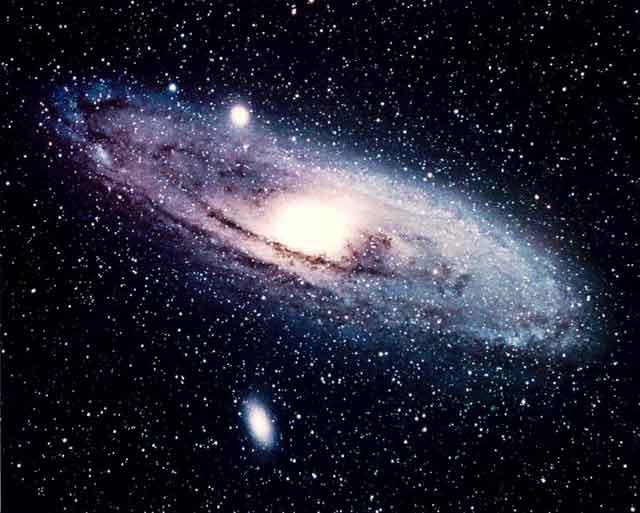
Ahoy, Lifers.  This is your Captain speaking.  Having been watching a lot of Cosmos lately, and having been inspired by Symphony of Science, I was reminded of an activity I used to enjoy in high school but that had fallen out of my routine in college.  I used to periodically visit NASA's Image of the Day page, which if you've never done I highly recommend.  They have some of the most remarkable and beautiful images you'll ever see (I considered describing them as "out of this world," but even the Life Despotic has standards).  I'm always impressed that the actual images of the cosmos exceed aesthetically even my most ideal conceptions of them.  To that end, I've done the legwork for you and collected here some of my favorite images from their archive.  That's right, my dear readers, fear not, for this is not another long-winded and poorly-reasoned meditation on astrophysics, but rather a modest collection of pretty pictures.  As I can't let you get away without having to read some text, however, I've paired the images with some of my favorite, most poignant quotes by our friend and cosmic mentor, Dr. Sagan.

Preach, Carl.

Twelve seconds to the moon

8.4.10
I know this will be two posts on astrophysics in a row, but after Everything Is Muted's post here, I can't leave space alone.  Plus, as she's the only one who reads my blog, I figure there won't be any complaints.  I decided I can't respond to her post directly, as I essentially agree with her basic idea and thus feel I couldn't add anything worthwhile to the dialogue.  Therefore, I've decided to continue the spirit of the conversation by pursuing the idea with which I ended my last post.

DISCLAIMER: At this point we are moving into the realm of complete hypothesis, speculation, and perhaps even sheer fantasy.  We ended with the problems of traveling near the speed of light, which is desirable for obvious reasons (read: Wookiee co-pilots).  To restate simply, traveling very close to the speed of light causes time to slow for the traveler while it runs normally for those of us left on Earth.  Thus, even traveling to the center of our Milky Way Galaxy in a mere eight years ship time would mean 30,000 years on Earth.

The word "galaxy" derives from the Greek galaxias, literally meaning "Milky Way."

The way we're going to overcome this problem is by using the fourth dimension.  I know, I know, but I'm actually not making this up.  You may have heard talk of the fourth dimension as being one of time.  That's not what we're talking about here.  We're talking about an actual fourth physical dimension.  So how does this all work, exactly?  Well, as much as I wish I could just point to it, we humans are unfortunately trapped in our three-dimensional world.

To try to understand it, then, let's take a step back.  Let's borrow Neil deGrasse Tyson's example of an ant walking along the edge of an opened newspaper.  Pretend the ant exists only in two dimensions, that is, length and width.  Obviously, the ant has height, as well as the ever so slim height of the newspaper, but let's just imagine.  If we, looking down on this flat world, wanted to help the ant travel from one edge of the paper to the other without having to walk all the way across, we could do so by introducing a third dimension.  That is, we could simply fold the pages up together, allowing the ant to move to the other page before setting them back down.  The ant has seemingly jumped from one side of the newspaper to the other in an exceedingly short period of time.  Most importantly, the ant, only able to perceive the two dimensions that define his existence, doesn't realize he's just traveled through the third dimension.

Clear as mud, right?  Let's just assume you know what I'm talking about and forge ahead, back to our three-dimensional world.  We know, thanks to Edwin "That Telescope Guy" Hubble, that the universe is expanding at a certain rate.  Think of this expanding universe as an open newspaper.  As it expands, it also curves.  This curvature of spacetime acts as the fold of the newspaper as it doubles back on itself.  This fold allows the possibility of a wormhole.  A wormhole is essentially a shortcut linking the two folds of space time, allowing you to travel from one side to the other faster than the speed of light, just like the ant was able to quickly "jump" from one side of the newspaper to the other.

This wormhole is visualized in three dimensions, but you get the idea.

STINGING REJOINDER: Hold on, there, space boy.  Special relativity says that nothing but light can travel at the speed of light.  Well, yes.  Going through the wormhole near the speed of light lets us reach a distant point in the universe faster than the time it would have taken light to reach it going around the fold.  Picture going through the tunnel versus following the red line in the diagram above.  Any light traveling through the wormhole with us still reaches the other side faster than we ever will.  Thus, special relativity is satisfied, and it doesn't take us tens or hundreds of thousands of Earth years to catch happy hour at the Mos Eisley Cantina (play it again, boys!).

Unfortunately, while relativistic physics allows for the existence of wormholes, there's no actual... er... evidence that they do.  That's not particularly unsurprising, as people far smarter than me are fairly certain that any possible wormholes would be extremely unstable and collapse in a matter of seconds.  So basically, utilizing this method would require us to figure out how to create and manipulate stable wormholes through the fourth dimension.  Simple, right?

MISGUIDED OPTIMISM: But hey, anything's possible.

From the fourth dimensional wormhole of Ivan Zissou

dictated but not read
cth

One voice in the cosmic fugue

7.4.10
I've been watching the Cosmos again with my soft-spoken and funky cool friend, Carl Sagan.  If you've never seen Cosmos, stop what you're doing right now and watch it immediately.  I'll be here 13 hours from now when you get back.  Having just watched the mind-bending episode on space travel and its relationship to time, I felt compelled to ponder the endless possibilities.

The concept of deep-space travel seems to be intrinsically compelling to us wee humans.  Maybe it's the prospect of new and unknown worlds.  Maybe it's because we like to go fast.  Or maybe, like George Mallory famously declared when asked why he wanted to climb Mount Everest, we want to explore the universe "because it's there."  Regardless of the reasoning, there's no denying that the idea of space travel is pretty wicked awesome.  UNANTICIPATED PESSIMISM: That's what makes it so unfortunate that the barriers to realizing this potential are so great.

The fundamental problem of deep-space travel is special relativity.  Thanks, Einstein.  OVERSIMPLIFICATION: In my never-having-taken-a-physics-class layman's understanding, special relativity basically states that all motion is relative, but that the speed of light (the c in E=mc2) is a constant against which all motion may be compared.  Furthermore, nothing (except light, of course) can travel at the speed of light.  You can travel at 99.999999% the speed of light, but you will never reach that asymptotic value.

Further complicating this whole situation is the fact that, as you approach closer and closer to the speed of light, weird stuff starts to happen.  The wavelengths of light become either shorter or longer, meaning that everything coming toward you turns blue and everything moving away turns red.  You get very skinny in the direction you're traveling.  This is not a product of perception, mind you, you actually get physically skinnier.

The biggest problem that special relativity introduces to us, however, is that as you approach the speed of light, your mass becomes heavier and heavier.  Why is this a problem?  Because it means that you'll need exponentially more and more massive amounts of energy to sustain your speed as it increases.  So where are we going to get this massive energy source?  Not sure.  Maybe nuclear fission.  More likely nuclear fusion.  Maybe some magical solution we haven't even conceived of yet.

SUDDEN DIGRESSION: Am I crazy, or do Carl Sagan, Neil Diamond, and Michigan State head football coach Mark Dantonio look like brothers?  Cousins, at the very least.


CONTINUATION: So, okay.  Let's just assume we find a magical power source that enables us to  travel up to 99.9999% the speed of light.  Woohoo!  We did it!  Let's break out the space colonies and Death Stars and blue-headed aliens, right?  Well, not quite.  Sorry, Han.

 Somebody just told Han a parsec is a unit of distance, not time.

Remember that weird stuff that happens as you approach the speed of light?  Well, the weirdest thing is a concept called time dilation.  Essentially, if you travel fast enough, time slows down.  Whu-whu-whu-whuuuuuut?  That's right, folks.  You actually age more slowly if you are traveling at the speed of light.  Sounds great, right?  The ultimate anti-aging cream.  Yes and no.  Say we could build a machine to take us to the center of the galaxy in only eight years ship time.  In Earth time, we would be traveling for some time on the order of 30,000 years.  The question at this point becomes the relative value of traveling through deep space, given the very real possibility that civilization as we know it would be long gone by the time of any potential return.

Is that it, then?  Are we forever doomed to linger in this boring old solar system?  (jk, Jupiter, keep doing what you're doing!)  Not necessarily.  So what is an alternative that might let us circumvent these apparently debilitating obstacles?  Where do we go from here?  Simple.

CLIFFHANGER: We go to the fourth dimension.

From the interstellar starship of Ivan Zissou

dictated but not read
cth